
- Other than a kit, what else do I need to start brewing?
- My mix is a little old. Is it still good?
- What do I do if my fermenter isn't filled to the One Gallon mark with liquid when I'm finished brewing?
- I just finished brewing, and my beer looks crazy. Did I mess up?
- There's crud around the inside of the fermenter. Is that bad?
-
How do I know if my beer is ready to be bottled?
Is an extra week in the fermenter reason to worry? - What do I do if my beer is over-carbonated?
- That was great. Can I reuse my kit?
- Where are you located? Do you have a store?
- You used to have a certain flavor, but now you don't. Where'd it go?
- How can my store carry your products?
- I'm not in the US, but I want to make beer. Can I order from you?
- I just got my kit. Where are my hops & yeast?
- I think something's wrong with my kit. What do I do?
Beer has been made for thousands of years, and up until prohibition in the US, it was just another part of keeping a house. Almost everyone made beer or at least had a friend that did (possibly because it was safer than water in a lot of places).
We think you should brew because there's nothing better than inviting friends over, giving them a beer, and saying "I made this!" It's carbonated. It's alcohol. It's beer, and because you used fresh, whole ingredients and brewed it the way people have for centuries, it's really good beer.
Yes! Homemade beer tastes great. When you brew using the same grain, hops, and yeast that craft breweries around the world use, you can make some really good beer -- beer that's as good if not better than what you'll find in stores. When you make it at home, you know where it was made, and you have access to the freshest beer you'll ever taste.
We originally designed our Beer Making Kit for New York City apartments, but we soon discovered that people across the country didn't want to dedicate an entire kitchen (basement, or garage) to making beer. And although we think our kit is pretty nice to look at (especially when it's full of beer), we never wanted to see it if we didn't have to. That's why our kit takes up less than 1 square foot of space. We usually leave ours in a closet or under the sink while it's fermenting. The only rule is you want to keep it somewhere dark.
Our Beer Making Kit takes the brewing process used in craft breweries around the world and scales it down to fit on the stovetop. We wanted to simplify brewing without dumbing it down by making it feel more like cooking. If you want to turn it into a science project, you can do that with our kit, and if you just want to make beer -- real beer from real ingredients -- this is the only kit designed specifically for you.
Absolutely! One of our first customers turned our Grapefruit Honey Ale into a Ginger Honey Ale by grating fresh ginger into it while brewing. Brewing has a long history of people putting, what might be thought of as, strange things into beer, and you're limited only by your imagination. The same goes for leaving certain things out of your beer. If you can't find chestnuts (or are allergic to them), leave them out of the Chestnut Brown Ale. You'll still end up with a great, full-flavored English Brown Ale. All of our flavors are for you to brew, play with, and make your own.
Yeast is creepy, but it's also really cool. It turns sugars into alcohol. While brewing, you're extracting sugars from grain (usually malted barley). The liquid you're left with will become your beer.
Hops do a lot for your beer. They're bitter, so they balance the sweetness you get from malted barley. They also contribute fresh aromas to your beer that can range from citrus, pine, flowers, grass, pepper, to an old man's couch (yes, really). There are dozens of varieties of hops in existence, and every year new ones crop up.
If you've ever made pasta, you should have everything you need to start brewing. Except for what's in the kit, you'll just need 2 or 3 stockpots (6 - 8 quarts are ideal), a large strainer, and a funnel. Check out our How to Brew Video for a better look at what you'll be using.
Two weeks after you brew, you'll need bottles with swing-tops or a couple six packs of regular, non-twist-off beer bottles with a capper and caps.
Bright light, extreme heat, and oxygen can be enemies to beer making ingredients, but thankfully we pack our ingredient mixes really well. As long as your mix is not kept in extreme conditions (ie: hot car or cold freezer), your Beer Making Mix will be good for up to a year after you received it.
While your beer boils, water evaporates. You want to keep it at a low, rolling boil. If your boil is very vigorous, extra water will evaporate from your beer. This means when you fill your fermenter, the liquid won't go all the way up to the One Gallon mark. To fix this, just add cold tap water to the fermenter until you're up to the One Gallon mark. Then proceed as normal.
A lot goes on while beer is fermenting. Your beer is becoming alcohol before your very eyes. It will change over time, and it might not even look like beer for a few days. So don't worry if your beer looks cloudy. Everything will settle to the bottom. Don't worry if your beer looks green for the first few hours. Hops are green, and they will settle to the bottom. In the end, don't worry. Beer will be beer, but if you're still not sure, just send us an email, and we'll help you out.
That crud is just yeast and sediment from your beer. It's a sign of an active fermentation, so it's definitely not a bad thing. If it gets in your blowoff tube, clean it out with a sanitizer solution and flush it with warm tap water. It may appear a little cloudy afterwards, but that's fine. Switch to the airlock if your beer's activity has slowed down.
Once you're finished brewing, keep your beer in a dark place and try your best to forget about it (the occasional peek is fine). After two weeks, check on your beer. Look at the surface of your beer for any sign of bubbles. Even the tiniest can mean your beer is still fermenting, so if you notice any, just come back in a few days. It's better to wait an extra week than it is to bottle too early. Bottling too early can contribute to over carbonated beer.
Bottle conditioning means you're carbonating your beer in bottles with a little sugar, usually in the form of honey or maple syrup diluted with a little warm water. You'll find bottle conditioning used in traditional breweries around the world, but it's also what you do at home. Over-carbonation can happen for a few reasons. The first possible reason is that your beer was bottled before it finished fermenting. See the question on knowing when to bottle to avoid this problem. Another possible reason is that too much sugar was added when bottling your beer. This can happen if you boil off too much liquid when brewing but still add the full amount of sugar for one gallon. See the question regarding what to do if your fermenter isn't filled up all the way to prevent this from happening. If your beer is over-carbonated, move all your bottles into the fridge. Colder temperatures will help stop additional carbonation while helping the beer absorb some of its CO2.
Sure! We made our Beer Making Kit with a high quality glass fermenter because glass doesn't harbor any bacteria that may otherwise be bad for your beer. All you need to do is clean your equipment with sanitizer and figure out what you'd like to brew next. All you need is another Beer Making Mix.
We don't have a store, but a lot of places across the country carry our products. We choose the retailers we work with very carefully because each one is in some way our store. We started out of the Brooklyn Flea, a great artisan market in Brooklyn, NY, and you can find us there every Saturday from April to November. And if you're in New York for the holidays, you can spot us at the Union Square Holiday Market from Thanksgiving to Christmas.
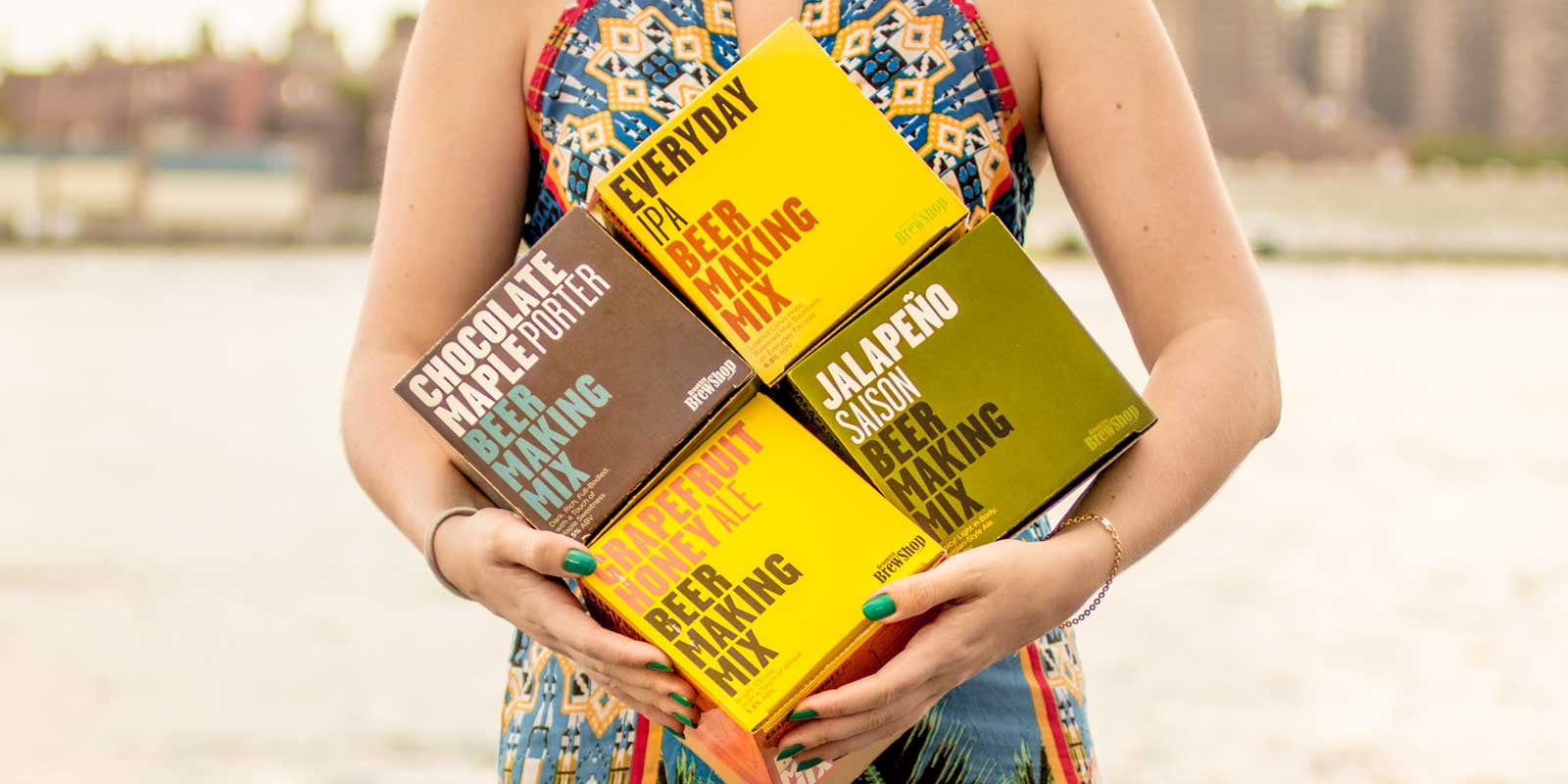
We don't always have the same mixes on our site throughout the year. The beers we make are seasonally inspired, so we change the mixes we offer with the seasons. Our retailers sometimes carry different mixes that you won't find on our site, so you may want to give your local retailer a call or visit. Otherwise, Brooklyn Brew Shop's Beer Making Book: 52 Seasonal Recipes for Small Batches features 52 seasonally inspired recipes so you'll be able to brew up that Gingerbread Ale in Summer or that JalapeƱo Saison in the dead of winter if you'd like.
To set up a wholesale account, please send us an email with your information and a little about your store.
Sure. We ship all over the country. You can even find our Beer Making Kits in stores across Canada, Europe, Africa, & Asia with our Store Locator. We're always open to suggestions for great international retailers, so if you have any, please send them our way.
To extend the life of the ingredients in our beer-making mixes, the packets of hops and yeast get packed along with the grain. They sometimes get buried under the grain like a kid's toy in an old box of cereal, so you may need to dig for them. If you still don't see them after looking through the bag, please send us an email.
We take quality very seriously, so if the order you received was broken or missing something, we want to know about it. Please send us an email detailing what is wrong, where it came from, and what your order number is (if you know it). We're glued to our inbox, so we'll get back to you as soon as we can with a solution.